


MRCPUK Endocrinology and Diabetes (Specialty Certificate Examination) - SEND Exam Questions
QUESTION NO: 1
A 35-year-old man presented with newly diagnosed type 2 diabetes mellitus. He had no medical history of note.
When should he inform the UK Driver and Vehicle Licensing Agency (DVLA) of his medical condition?
A 35-year-old man presented with newly diagnosed type 2 diabetes mellitus. He had no medical history of note.
When should he inform the UK Driver and Vehicle Licensing Agency (DVLA) of his medical condition?
Correct Answer: D
QUESTION NO: 2
A 27-year-old woman presented with a 6-month history of amenorrhoea and low mood. She complained of headaches but no visual disturbance. Her past medical history included anorexia nervosa but her current weight was stable.
On examination, her body mass index was 20.2 kg/m2 (18-25). Routine physical examination was normal and there was no galactorrhoea. Visual fields were full to confrontation.
Investigations:
serum cortisol (09.00 h)320 nmol/L (200-700)
short tetracosactide (Synacthen@) test (250 micrograms): serum cortisol (30 min after tetracosactide)630 nmol/L (>550) serum oestradiol200 pmol/L (200-400) plasma follicle-stimulating hormone2 U/L (2.5-10.0) plasma luteinising hormone4 U/L (2.5-10.0)
serum prolactin1001 mU/L (<360) serum free T418.0 pmol/L (10.0-22.0)
serum ?-human chorionic gonadotropin<5 U/L (<5)
What is the most appropriate next step in management?
A 27-year-old woman presented with a 6-month history of amenorrhoea and low mood. She complained of headaches but no visual disturbance. Her past medical history included anorexia nervosa but her current weight was stable.
On examination, her body mass index was 20.2 kg/m2 (18-25). Routine physical examination was normal and there was no galactorrhoea. Visual fields were full to confrontation.
Investigations:
serum cortisol (09.00 h)320 nmol/L (200-700)
short tetracosactide (Synacthen@) test (250 micrograms): serum cortisol (30 min after tetracosactide)630 nmol/L (>550) serum oestradiol200 pmol/L (200-400) plasma follicle-stimulating hormone2 U/L (2.5-10.0) plasma luteinising hormone4 U/L (2.5-10.0)
serum prolactin1001 mU/L (<360) serum free T418.0 pmol/L (10.0-22.0)
serum ?-human chorionic gonadotropin<5 U/L (<5)
What is the most appropriate next step in management?
Correct Answer: C
QUESTION NO: 3
A 56-year-old man with a 5-year history of type 2 diabetes mellitus was worried about developing a foot ulcer.
Which clinical feature, if present, best predicts the development of a foot ulcer in a patient with diabetes?
A 56-year-old man with a 5-year history of type 2 diabetes mellitus was worried about developing a foot ulcer.
Which clinical feature, if present, best predicts the development of a foot ulcer in a patient with diabetes?
Correct Answer: C
QUESTION NO: 4
A 58-year-old man presented with tiredness and breathlessness. He had been treated for type 2 diabetes mellitus and hypertension for the past 10 years. He was free of complications. His current medication included ramipril 10 mg daily, rosuvastatin 10 mg daily, metformin 500 mg three times daily, dapagliflozin 10 mg once daily and exenatide 10 micrograms twice daily.
On examination, his body mass index was 36 kg/m2 (18-25).
Investigations:
haemoglobin93 g/L (130-180)
MCV110 fL (80-96)
white cell count3.6 ? 109/L (4.0-11.0)
platelet count140 ? 109/L (150-400)
reticulocyte count0.5% (0.5-2.4)
serum ferritin250 ug/L (15-300)
serum vitamin B1240 ng/L (160-760)
serum folate3.0 ug/L (2.0-11.0)
Which medication is most likely to be contributing to his anaemia?
A 58-year-old man presented with tiredness and breathlessness. He had been treated for type 2 diabetes mellitus and hypertension for the past 10 years. He was free of complications. His current medication included ramipril 10 mg daily, rosuvastatin 10 mg daily, metformin 500 mg three times daily, dapagliflozin 10 mg once daily and exenatide 10 micrograms twice daily.
On examination, his body mass index was 36 kg/m2 (18-25).
Investigations:
haemoglobin93 g/L (130-180)
MCV110 fL (80-96)
white cell count3.6 ? 109/L (4.0-11.0)
platelet count140 ? 109/L (150-400)
reticulocyte count0.5% (0.5-2.4)
serum ferritin250 ug/L (15-300)
serum vitamin B1240 ng/L (160-760)
serum folate3.0 ug/L (2.0-11.0)
Which medication is most likely to be contributing to his anaemia?
Correct Answer: D
QUESTION NO: 5
A 78-year-old man presented with confusion, lethargy and thirst. He had hypertension treated with lisinopril 20 mg daily.
On examination, he was dehydrated. His pulse was 110 beats per minute and his blood pressure was 84/40 mmHg. Urinalysis showed ketones 1+.
Investigations:
serum sodium155 mmol/L (137-144) serum potassium5.2 mmol/L (3.5-4.9) serum bicarbonate17 mmol/L (20-28) serum urea40.0 mmol/L (2.5-7.0)
serum creatinine358 umol/L (60-110) random plasma glucose78.0 mmol/L He was treated with sodium chloride 0.9%. After 8 hours' treatment, his urine output was
10 mL/h and his blood pressure was 121/50 mmHg. Investigations (after 8 hours' treatment): serum sodium151 mmol/L (137-144)
serum potassium4.9 mmol/L (3.5-4.9) serum bicarbonate18 mmol/L (20-28) serum urea39.0 mmol/L (2.5-7.0) serum creatinine347 umol/L (60-110)
random plasma glucose48.0 mmol/L
What is the most appropriate next step in management?
A 78-year-old man presented with confusion, lethargy and thirst. He had hypertension treated with lisinopril 20 mg daily.
On examination, he was dehydrated. His pulse was 110 beats per minute and his blood pressure was 84/40 mmHg. Urinalysis showed ketones 1+.
Investigations:
serum sodium155 mmol/L (137-144) serum potassium5.2 mmol/L (3.5-4.9) serum bicarbonate17 mmol/L (20-28) serum urea40.0 mmol/L (2.5-7.0)
serum creatinine358 umol/L (60-110) random plasma glucose78.0 mmol/L He was treated with sodium chloride 0.9%. After 8 hours' treatment, his urine output was
10 mL/h and his blood pressure was 121/50 mmHg. Investigations (after 8 hours' treatment): serum sodium151 mmol/L (137-144)
serum potassium4.9 mmol/L (3.5-4.9) serum bicarbonate18 mmol/L (20-28) serum urea39.0 mmol/L (2.5-7.0) serum creatinine347 umol/L (60-110)
random plasma glucose48.0 mmol/L
What is the most appropriate next step in management?
Correct Answer: B
QUESTION NO: 6
A 72-year-old woman was referred for bone density assessment after sustaining a fracture of her right ankle after a minor fall. She had previously fractured her right wrist after tripping in the street. Her past medical history included occasional angina relieved by glyceryl trinitrate spray and a previous deep venous thrombosis. Her medication comprised aspirin, simvastatin, alendronic acid, and calcium and vitamin D, which she had been taking regularly for 2 years.
Investigations:
DXA scan of spine (L2-L4)T score -2.4
DXA scan of total hipT score -2.8
What is the most appropriate treatment?
A 72-year-old woman was referred for bone density assessment after sustaining a fracture of her right ankle after a minor fall. She had previously fractured her right wrist after tripping in the street. Her past medical history included occasional angina relieved by glyceryl trinitrate spray and a previous deep venous thrombosis. Her medication comprised aspirin, simvastatin, alendronic acid, and calcium and vitamin D, which she had been taking regularly for 2 years.
Investigations:
DXA scan of spine (L2-L4)T score -2.4
DXA scan of total hipT score -2.8
What is the most appropriate treatment?
Correct Answer: A
QUESTION NO: 7
A 26-year-old woman was recovering from diabetic ketoacidosis and had been switched to her usual basal bolus insulin regimen. Her capillary blood glucose measurements during the day were high but fasting plasma glucose was in the range 5.0-7.0 mmol/L (3.0-6.0). She was drinking and eating normally.
On examination, her pulse was 76 beats per minute and her blood pressure was 106/66 mmHg. Urinalysis showed ketones 1+.
Investigations:
serum sodium143 mmol/L (137-144)
serum potassium4.4 mmol/L (3.5-4.9)
serum bicarbonate22 mmol/L (20-28)
serum creatinine72 umol/L (60-110)
plasma glucose 2 h after breakfast21 mmol/L
What is the most appropriate next step in management?
A 26-year-old woman was recovering from diabetic ketoacidosis and had been switched to her usual basal bolus insulin regimen. Her capillary blood glucose measurements during the day were high but fasting plasma glucose was in the range 5.0-7.0 mmol/L (3.0-6.0). She was drinking and eating normally.
On examination, her pulse was 76 beats per minute and her blood pressure was 106/66 mmHg. Urinalysis showed ketones 1+.
Investigations:
serum sodium143 mmol/L (137-144)
serum potassium4.4 mmol/L (3.5-4.9)
serum bicarbonate22 mmol/L (20-28)
serum creatinine72 umol/L (60-110)
plasma glucose 2 h after breakfast21 mmol/L
What is the most appropriate next step in management?
Correct Answer: D
QUESTION NO: 8
A 33-year-old woman, who was 9 weeks into her first pregnancy, was admitted with prolonged vomiting and secondary dehydration. She had lost 6 kg in weight since becoming pregnant. There was a strong family history of thyroid disease: two sisters were hypothyroid and one brother had required radioactive iodine for Graves' disease.
On examination, she had a smooth, small goitre. Her pulse was 94 beats per minute and her blood pressure was 104/42 mmHg. There was a tremor of the outstretched hands. Urinalysis was normal.
Investigations:
serum sodium143 mmol/L (137-144) serum potassium4.4 mmol/L (3.5-4.9)
serum creatinine105 umol/L (60-110)
serum thyroid-stimulating hormone (TSH)<0.01 mU/L (0.4-5.0)
serum free T424.0 pmol/L (10.0-22.0)
serum free T311.0 pmol/L (3.0-7.0)
A TSH receptor antibody concentration was awaited.
In addition to rehydration, what is the most appropriate next step in the management of her abnormal thyroid function?
A 33-year-old woman, who was 9 weeks into her first pregnancy, was admitted with prolonged vomiting and secondary dehydration. She had lost 6 kg in weight since becoming pregnant. There was a strong family history of thyroid disease: two sisters were hypothyroid and one brother had required radioactive iodine for Graves' disease.
On examination, she had a smooth, small goitre. Her pulse was 94 beats per minute and her blood pressure was 104/42 mmHg. There was a tremor of the outstretched hands. Urinalysis was normal.
Investigations:
serum sodium143 mmol/L (137-144) serum potassium4.4 mmol/L (3.5-4.9)
serum creatinine105 umol/L (60-110)
serum thyroid-stimulating hormone (TSH)<0.01 mU/L (0.4-5.0)
serum free T424.0 pmol/L (10.0-22.0)
serum free T311.0 pmol/L (3.0-7.0)
A TSH receptor antibody concentration was awaited.
In addition to rehydration, what is the most appropriate next step in the management of her abnormal thyroid function?
Correct Answer: C
QUESTION NO: 9
A 55-year-old woman presented with a 3-week history of nausea and vomiting. Her only medical complaints were frequent dyspepsia, for which she was taking indigestion tablets, and asthma for which she was taking a salbutamol inhaler as required.
On examination, there was no evidence of lymphadenopathy, her chest was clear on auscultation and abdominal examination was normal.
Investigations (before and after taking omeprazole for 3 weeks):
beforeafternormal erythrocyte sedimentation rate (mm/1st h)44<30 serum creatinine (umol/L)17011060-110 serum corrected calcium (mmol/L)2.852.402.20-2.60
serum phosphate (mmol/L)1.90.8-1.4
serum angiotensin-converting enzyme (U/L)8525-82
plasma parathyroid hormone (pmol/L)0.44.40.9-5.4
What is the most likely cause of the hypercalcaemia?
A 55-year-old woman presented with a 3-week history of nausea and vomiting. Her only medical complaints were frequent dyspepsia, for which she was taking indigestion tablets, and asthma for which she was taking a salbutamol inhaler as required.
On examination, there was no evidence of lymphadenopathy, her chest was clear on auscultation and abdominal examination was normal.
Investigations (before and after taking omeprazole for 3 weeks):
beforeafternormal erythrocyte sedimentation rate (mm/1st h)44<30 serum creatinine (umol/L)17011060-110 serum corrected calcium (mmol/L)2.852.402.20-2.60
serum phosphate (mmol/L)1.90.8-1.4
serum angiotensin-converting enzyme (U/L)8525-82
plasma parathyroid hormone (pmol/L)0.44.40.9-5.4
What is the most likely cause of the hypercalcaemia?
Correct Answer: A
QUESTION NO: 10
A 55-year-old woman presented complaining of difficulty losing weight.
On examination, her blood pressure was 170/105 mmHg and urinalysis showed protein 1+.
An ultrasound scan of abdomen revealed a 4.5-cm solid lesion in the right adrenal gland. She was treated with ramipril and further endocrine evaluation was performed.
Investigations:
serum potassium3.6 mmol/L (3.5-4.9)
serum creatinine135 umol/L (60-110)
plasma renin activity:
(after 30 min supine)3.9 pmol/mL/h (1.1-2.7)
(after 30 min upright)6.8 pmol/mL/h (3.0-4.3)
plasma aldosterone:
(after 30 min supine)150 pmol/L (135-400)
(after 4 h upright)350 pmol/L (330-830)
serum cortisol (09.00 h)650 nmol/L (200-700)
serum cortisol (22.00 h)225 nmol/L (50-250)
24-h urinary free cortisol230 nmol (55-250)
24-h urinary dopamine3200 nmol (<3100)
24-h urinary adrenaline120 nmol (<144)
24-h urinary noradrenaline450 nmol (<570)
What is the most appropriate initial management of the adrenal lesion?
A 55-year-old woman presented complaining of difficulty losing weight.
On examination, her blood pressure was 170/105 mmHg and urinalysis showed protein 1+.
An ultrasound scan of abdomen revealed a 4.5-cm solid lesion in the right adrenal gland. She was treated with ramipril and further endocrine evaluation was performed.
Investigations:
serum potassium3.6 mmol/L (3.5-4.9)
serum creatinine135 umol/L (60-110)
plasma renin activity:
(after 30 min supine)3.9 pmol/mL/h (1.1-2.7)
(after 30 min upright)6.8 pmol/mL/h (3.0-4.3)
plasma aldosterone:
(after 30 min supine)150 pmol/L (135-400)
(after 4 h upright)350 pmol/L (330-830)
serum cortisol (09.00 h)650 nmol/L (200-700)
serum cortisol (22.00 h)225 nmol/L (50-250)
24-h urinary free cortisol230 nmol (55-250)
24-h urinary dopamine3200 nmol (<3100)
24-h urinary adrenaline120 nmol (<144)
24-h urinary noradrenaline450 nmol (<570)
What is the most appropriate initial management of the adrenal lesion?
Correct Answer: D
QUESTION NO: 11
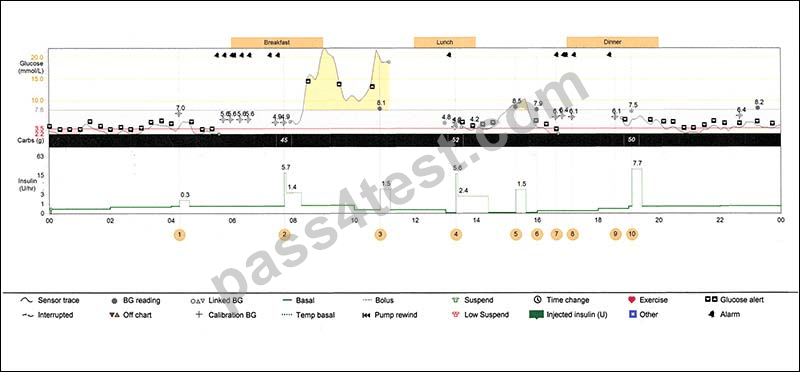
A 33-year-old woman was reviewed in the insulin pump clinic. She had had type 1 diabetes mellitus for 10 years. She had been treated with a continuous subcutaneous insulin infusion 3 years previously, because of frequent hypoglycaemic episodes. She had recently undergone continuous glucose monitoring (see image).
Investigations:
haemoglobin A1c43 mmol/mol (20-42)
What is the most likely cause of the blood glucose trace seen between 08.00 h and 10.00 h?
A 33-year-old woman was reviewed in the insulin pump clinic. She had had type 1 diabetes mellitus for 10 years. She had been treated with a continuous subcutaneous insulin infusion 3 years previously, because of frequent hypoglycaemic episodes. She had recently undergone continuous glucose monitoring (see image).
Investigations:
haemoglobin A1c43 mmol/mol (20-42)
What is the most likely cause of the blood glucose trace seen between 08.00 h and 10.00 h?
Correct Answer: A
QUESTION NO: 12
A 77-year-old woman presented with acute severe pain in the mid-thoracic spine after lifting a heavy bag of shopping. She had reported losing 6 cm in height over the preceding 5 years.
On examination, she was of slight build and experienced difficulty rising from a chair. There was tenderness in the region of T9/10.
Investigations:
plain thoracic X-ray of spinewedge fracture of T10
DXA scanT score -2.7 at L1-L4 and -2.3 at
the left total hip
What is the best estimate for the proportion of vertebral fractures that present clinically with back pain, as seen in this patient?
A 77-year-old woman presented with acute severe pain in the mid-thoracic spine after lifting a heavy bag of shopping. She had reported losing 6 cm in height over the preceding 5 years.
On examination, she was of slight build and experienced difficulty rising from a chair. There was tenderness in the region of T9/10.
Investigations:
plain thoracic X-ray of spinewedge fracture of T10
DXA scanT score -2.7 at L1-L4 and -2.3 at
the left total hip
What is the best estimate for the proportion of vertebral fractures that present clinically with back pain, as seen in this patient?
Correct Answer: E
QUESTION NO: 13
A 72-year-old man with a 12-year history of type 2 diabetes mellitus was found to have carcinoma of the bladder. He was taking metformin; however, this was stopped because of his deteriorating renal function.
On examination, his weight was 95 kg and his body mass index was 32 kg/m2 (18-25).
Investigations:
serum sodium143 mmol/L (137-144)
serum potassium4.4 mmol/L (3.5-4.9)
serum creatinine175 umol/L (60-110)
estimated glomerular filtration rate (MDRD)27 mL/min/1.73 m2 (>60)
haemoglobin A1c64 mmol/mol (20-42)
What is the most appropriate addition to his medication?
A 72-year-old man with a 12-year history of type 2 diabetes mellitus was found to have carcinoma of the bladder. He was taking metformin; however, this was stopped because of his deteriorating renal function.
On examination, his weight was 95 kg and his body mass index was 32 kg/m2 (18-25).
Investigations:
serum sodium143 mmol/L (137-144)
serum potassium4.4 mmol/L (3.5-4.9)
serum creatinine175 umol/L (60-110)
estimated glomerular filtration rate (MDRD)27 mL/min/1.73 m2 (>60)
haemoglobin A1c64 mmol/mol (20-42)
What is the most appropriate addition to his medication?
Correct Answer: E
QUESTION NO: 14
A 55-year-old male-to-female transsexual was reviewed in clinic. She lived as a woman but had not undergone gender reassignment surgery. She was treated with cyproterone acetate 50 mg twice daily and estradiol 2 mg twice daily.
What are the most important tests for monitoring safe replacement?
A 55-year-old male-to-female transsexual was reviewed in clinic. She lived as a woman but had not undergone gender reassignment surgery. She was treated with cyproterone acetate 50 mg twice daily and estradiol 2 mg twice daily.
What are the most important tests for monitoring safe replacement?
Correct Answer: D
QUESTION NO: 15
A 16-year-old boy was referred with concern about delayed puberty. His stature had been short as a child. He reported an increase in height at the age of 13, and had begun to develop pubic hair at the age of 14. He reported no further growth or development in the past year. His father recalled going through puberty at the age of 13.
On examination, his height was 1.60 m (between 0.4th and 2nd centile), weight was 56.4 kg (between 9th and 25th centile), genital development was Tanner stage 2 and testicular volume was 8 mL bilaterally. Pubic hair was Tanner stage 2, with no evidence of androgenic axillary hair. Bone age at the left wrist was 13.5 years.
Investigations:
serum testosterone2.9 nmol/L (9.0-35.0)
Which feature in his clinical presentation most strongly suggests a diagnosis other than constitutional delay?
A 16-year-old boy was referred with concern about delayed puberty. His stature had been short as a child. He reported an increase in height at the age of 13, and had begun to develop pubic hair at the age of 14. He reported no further growth or development in the past year. His father recalled going through puberty at the age of 13.
On examination, his height was 1.60 m (between 0.4th and 2nd centile), weight was 56.4 kg (between 9th and 25th centile), genital development was Tanner stage 2 and testicular volume was 8 mL bilaterally. Pubic hair was Tanner stage 2, with no evidence of androgenic axillary hair. Bone age at the left wrist was 13.5 years.
Investigations:
serum testosterone2.9 nmol/L (9.0-35.0)
Which feature in his clinical presentation most strongly suggests a diagnosis other than constitutional delay?
Correct Answer: A

